A generation growing up under attack
There are stories that should never belong to childhood. A child should not know the sound of an incoming missile. A child should not learn how to run to a shelter before learning how to feel safe at home. A child should not be taken from their family, moved across borders, placed under guard, or told that their identity no longer belongs to them.
Yet since Russia’s full-scale invasion of Ukraine in February 2022, this has become the lived reality for thousands of Ukrainian children.
They have lived through missile strikes, occupation, displacement, separation from family, life-changing injuries, captivity, and forced transfer. The European Commission states that an estimated 20,000 Ukrainian children have been unlawfully deported or forcibly transferred to Russia and temporarily occupied territories, with only a fraction returned to Ukraine.
The UN Independent International Commission of Inquiry on Ukraine concluded in March 2026 that Russia’s deportation and forcible transfer of Ukrainian children amount to crimes against humanity, as well as war crimes.
These are not abstract figures. They are children with names. With families. With memories. With futures that were interrupted before they had the chance to fully begin.
A film that brings their voices forward
The documentary Children in the Fire, directed by Oscar-nominated filmmaker Evgeny Afineevsky, brings these stories into view.
Returning to Ukraine after his acclaimed work Winter on Fire: Ukraine’s Fight for Freedom, Afineevsky turns his lens toward children whose lives have been shaped by Russia’s war. The film is described as a collective war diary of resilient Ukrainian children who survived abductions and attacks, yet remain determined to pursue their futures as athletes, performers, students, and public servants.
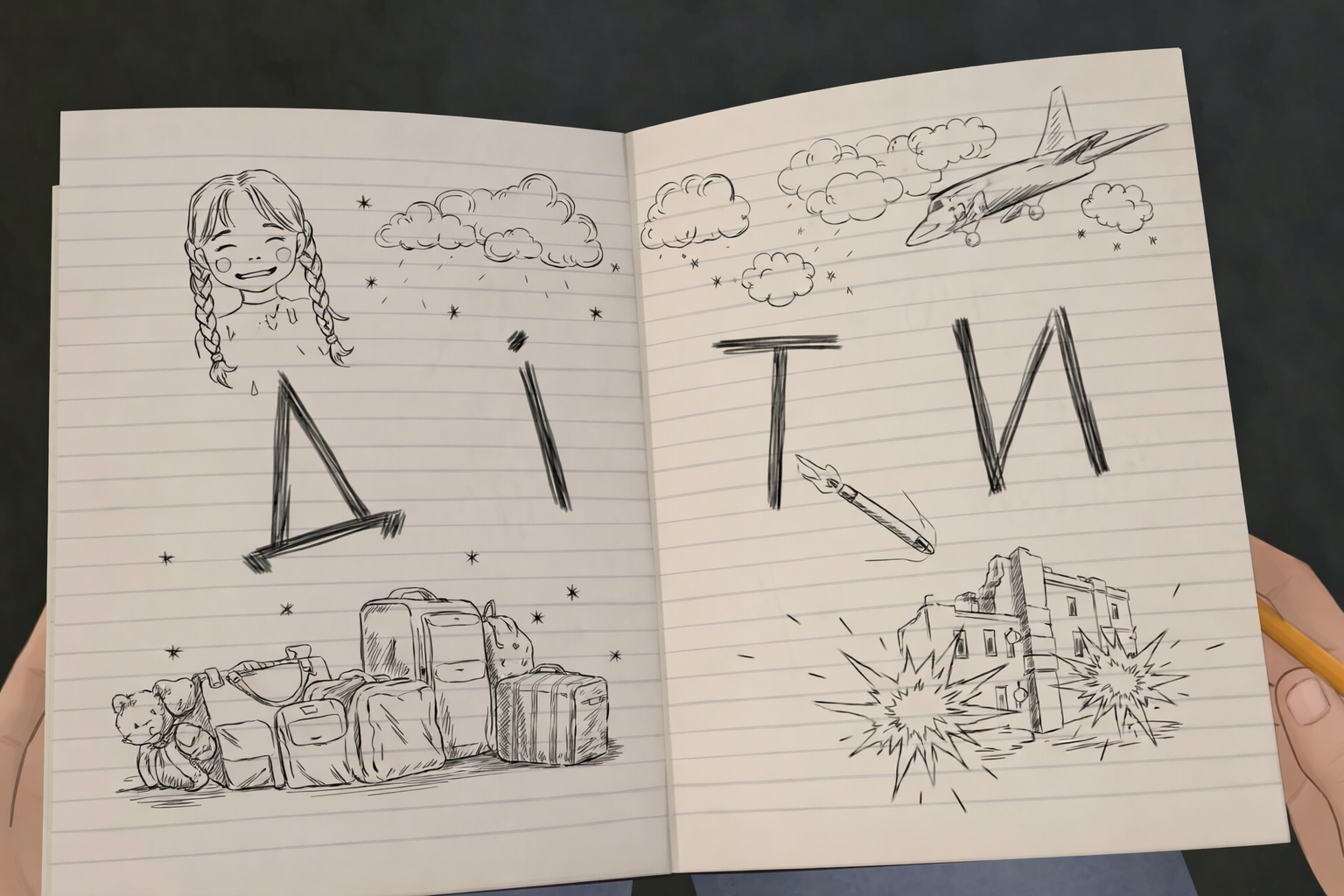
The film combines real footage with animation, giving space to what is often hardest to show directly: fear, trauma, memory, and the inner world of a child trying to survive what no child should ever face.
It follows children who have endured:
- abduction and forced relocation;
- missile strikes and severe injuries;
- captivity and psychological trauma;
- displacement and loss of home;
- separation from family and community.
But this is not only a film about suffering. It is also a film about endurance. These children continue to study. They continue to train. They continue to dream. They continue to choose life, even after war tried to define it for them.
Valeriia: taken at 16
Valeriia Sydorova was 16 when Russian forces occupied her hometown in southern Ukraine. She was told she would be taken to Crimea for two weeks. Instead, she was transported to a guarded camp. There, her documents were taken. Her Ukrainian language was suppressed. Her identity was challenged.
Each day began with the Russian national anthem. Children were made to raise the Russian flag and follow imposed routines designed not only to control them, but to reshape how they understood themselves.
“The camp was like a cage,” she later said.
Months later, Valeriia escaped. She travelled through checkpoints and crossed dangerous terrain to reach Ukrainian-controlled territory.
Today, she lives in Kyiv and studies nursing. Her goal is simple and powerful: to help others. That is what war could not take from her.
Vladislav: surviving captivity
Vladislav Buryak was also 16 when he was stopped at a checkpoint.
Russian soldiers searched his phone. On it, they found videos showing captured Russian soldiers speaking against the war. That was enough. He was taken at gunpoint. For 48 days, Vladislav was held in a small cell in a police station in occupied territory. He witnessed detainees being tortured. He was forced to clean the cells afterward.
“My brain started to erase childhood memories,” he later recalled.
Eventually, he was transferred to a hotel under guard — still a prisoner. Then, one day, without warning, he was driven to a checkpoint and released. His father was waiting on the other side. Today, Vladislav studies and works abroad. He hopes to build a future in diplomacy and international relations. He wants to help prevent what happened to him from happening to others.
That is what survival can become when the world listens: not only memory, but purpose.
More than individual stories
Valeriia and Vladislav are not exceptions. They are part of a wider reality faced by Ukrainian children under Russia’s war.
Thousands of children have been killed or injured. Millions have been displaced inside Ukraine and abroad. Schools, hospitals, homes, playgrounds, and family spaces have been damaged or destroyed. The Council of Europe has noted that children across Ukraine have faced death, displacement, loss of family members, destruction of homes, and major disruption to education.
This is not only a humanitarian crisis. It is a generational wound. When a child loses safety, the damage does not end when the siren stops. It follows them into sleep, into school, into relationships, into the way they understand the world and their place in it.
And still, Ukrainian children continue to live. Not because the world has done enough. But because they have had to become stronger than any child should be asked to become.
Why these stories matter
Children in the Fire does not exist to shock the audience. It exists to make silence impossible. It asks you to see what can become invisible when war is repeated daily in headlines. It asks you to understand that behind every statistic is a child who once had an ordinary life — a room, a school, a favorite song, a family routine, a dream.
This is also the mission of the Sound of Life campaign. In Ukraine today, some parents place a small whistle around their child’s neck before bedtime. Not as a toy. Not as a symbol. But as a survival tool. If a missile strike destroys their home, and the child is trapped beneath the rubble, the whistle may help rescuers find them.
A simple object. A signal of survival.
The whistle represents a reality no child should know: the need to prepare for disaster before going to sleep. This campaign framing is rooted in the understanding that, for Ukrainian families, the whistle is not symbolic — it is part of the daily fear and preparation imposed by war.
And still, even in this reality, the Sound of Life campaign insists on something essential: Ukrainian children are not defined only by what has been done to them. Their laughter, courage, and hope remain the reason to keep working, advocating, and acting.
Protecting the future means protecting children now
Protecting children in wartime is not theoretical. It is immediate. It means stopping attacks before they reach homes, schools, hospitals, and shelters. Air defense is civilian protection. Air defense is child protection.
When missiles and drones are intercepted:
- homes remain standing;
- families stay together;
- rescuers are not digging through rubble;
- children survive the night.
This is the message the world must understand clearly: air defense is not only a military issue. It is a humanitarian necessity. It is about whether children wake up in their own beds. Whether parents see them in the morning. Whether a whistle remains unused.
A shared responsibility
You do not need to be Ukrainian to understand what is at stake. You only need to imagine a child you love. Imagine placing a whistle around their neck before bedtime — not for play, not for safety on a school trip, but because a missile may hit their home while they sleep. Then ask what kind of world accepts this as normal.
The stories in Children in the Fire ask for more than attention. They ask for awareness. For responsibility. For action. Because every child deserves more than survival. Every child deserves safety. Every child deserves childhood. Every child deserves a future.
Watch the trailer and learn more about Children in the Fire: